- Mar 19, 2024
Time Slicing in Network Modeling
- Chaomei Chen
- 0 comments
What does time slicing do in CiteSpace? Why and when should we use it?
A network is an abstract representation of connections, typically and often implicitly over a specific time frame. For example, a connection introduced 30 years ago might have made a brief appearance without attracting any attention. To many people, it's as if it never existed. In contrast, a recently discovered connection could emerge at the center of attention, repeatedly discussed and utilized. Visualizing the underlying activities as a network needs to choose a time frame that is suitable to what we are looking for. This is akin to astronomers selecting the exposure time for a telescope when studying deep space.
CiteSpace constructs several types of networks to characterize the development of the intellectual landscape of a field of research. The default time slicing setting is to take a snapshot once every year. For example, from 1990 through 2003, we would get 14 snapshots of the underlying network. Or, we could get 1 snapshot with an exposure time of 14 years. What differences can we expect if we choose time slices differently?
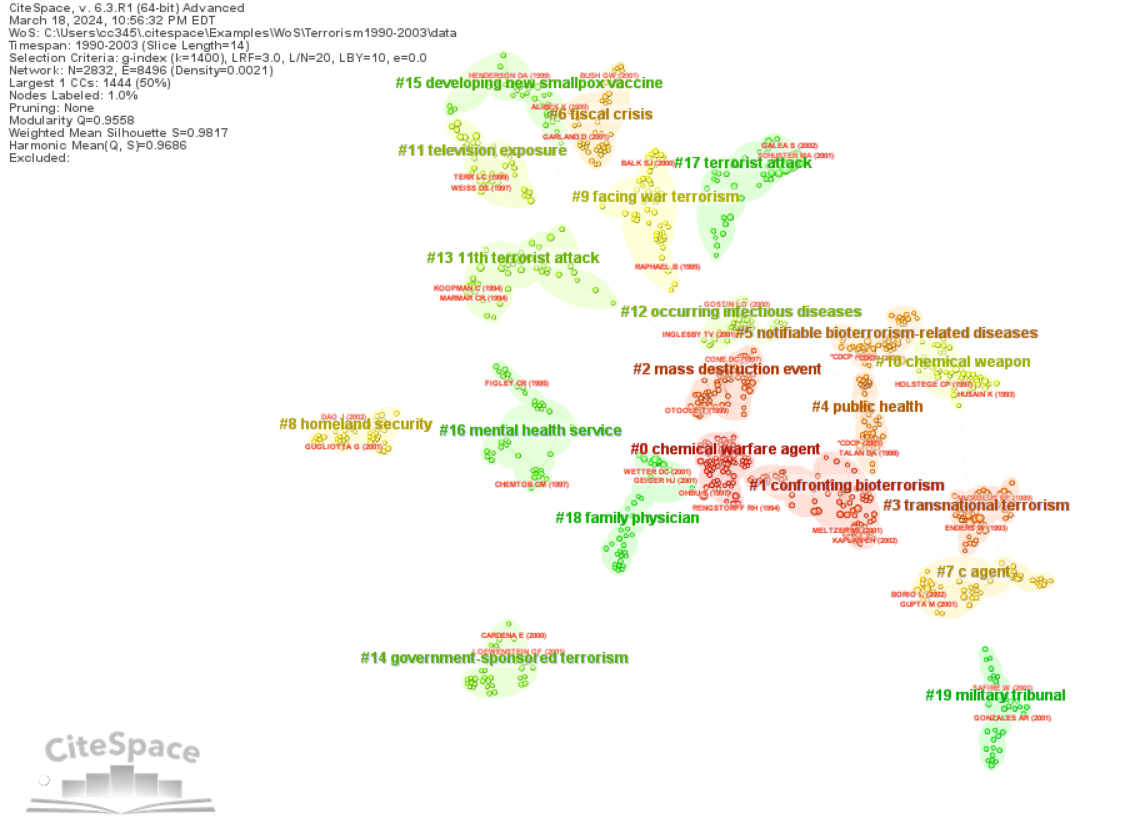
The following examples use the Terrorism dataset, which comes with the distribution of CiteSpace. The first example shows a single snapshot with a 14-year exposure. Major topics include chemical warfare agent, confronting bioterrorism, and mass destruction event.
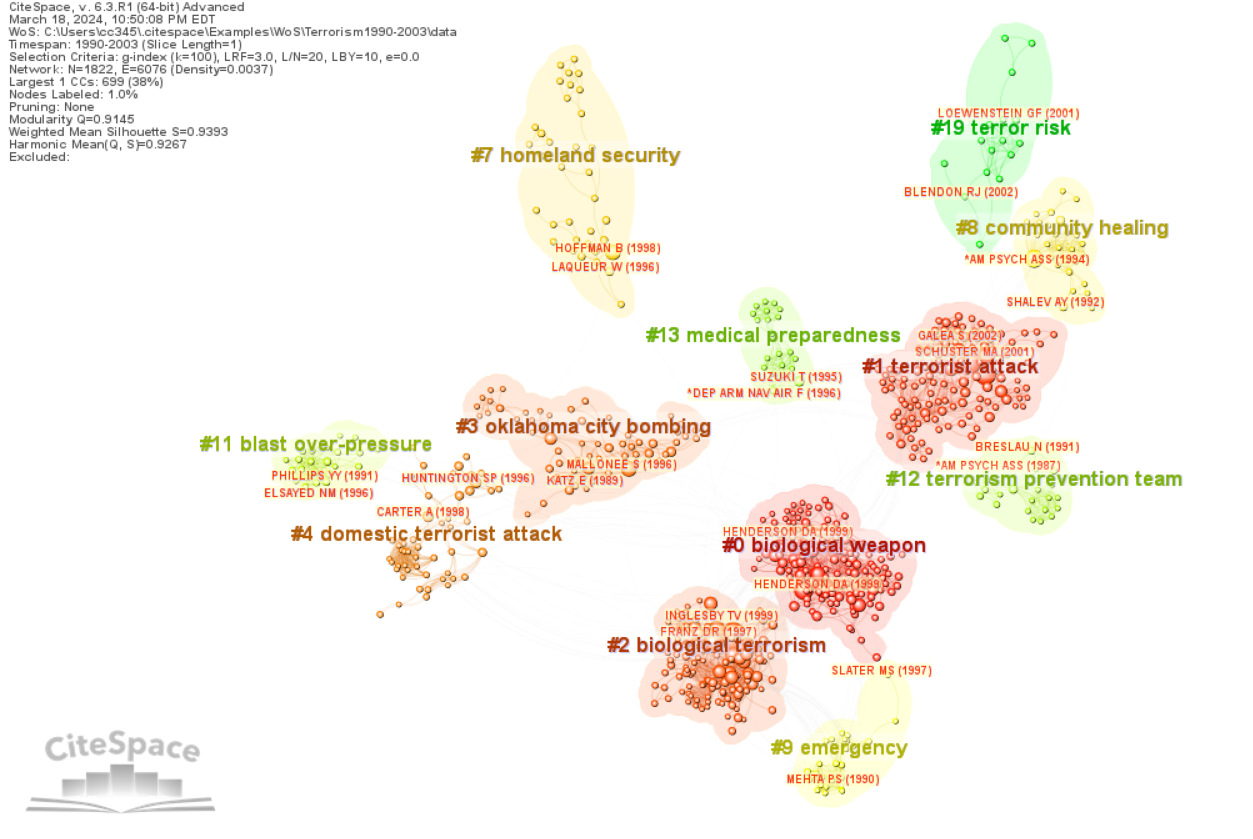
The following network is synthesized from 14 1-year snapshots. Major topics include biological weapon, terrorist attack, and biological terrorism. Mallonee (1996) appeared as one of the major works in the Oklahoma city bombing cluster in this version, but it was not featured in the single snapshot network. For details on the importance of this work, see Chen 2004 PNAS and Chen 2006 JASIST.
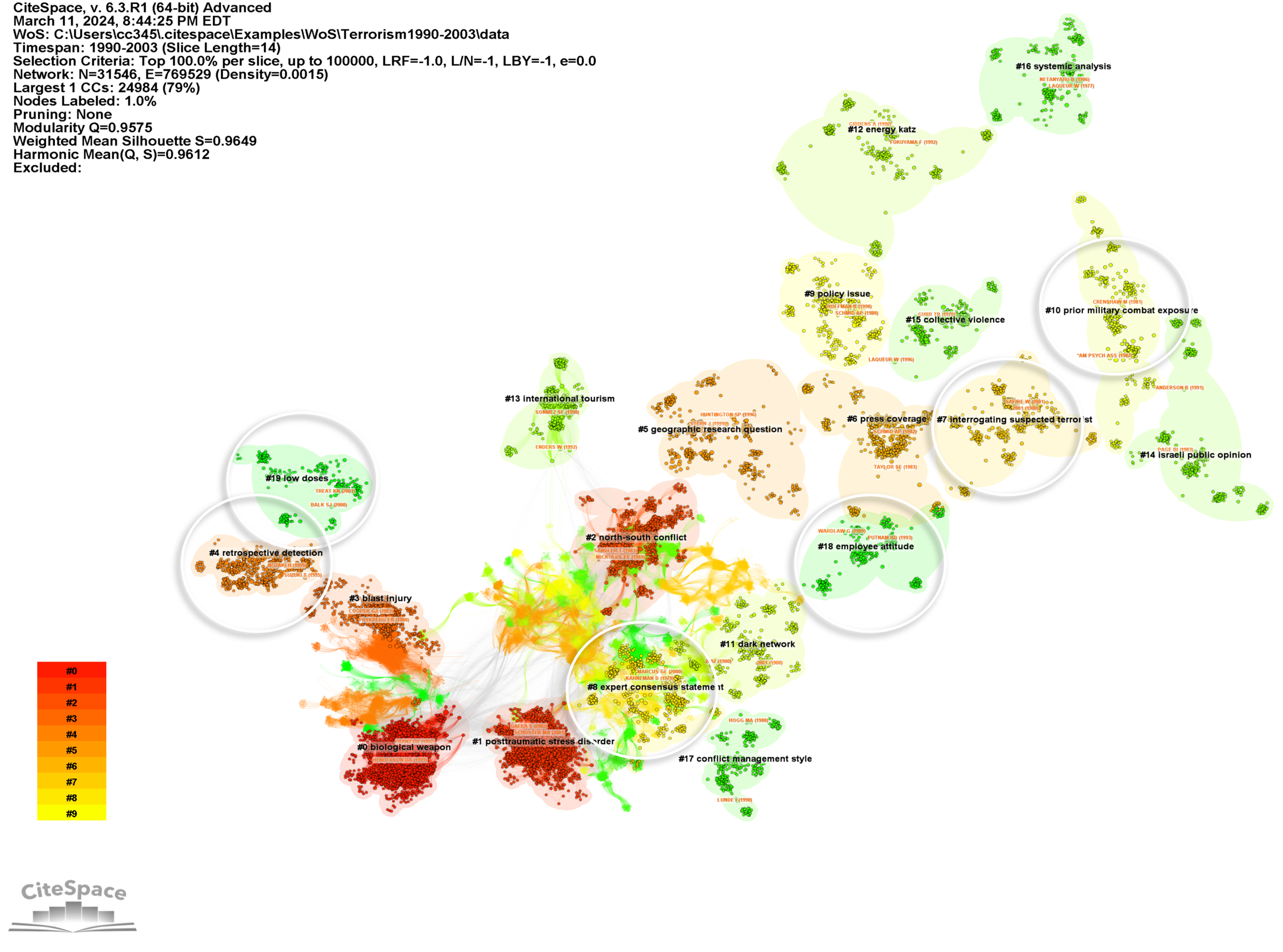
To make the comparison more comparable, the following two networks are constructed with the entire dataset, i.e., all the connections are taken into account. As usual, we focus on the largest connected component of each network. With the single snapshot version, i.e., no time slicing, the largest connected component contains 24,984 cited references, which is 79% of the entire network. Circled clusters are those that only found in this network but not in its time slicing counterpart.
Finally, this is the time-slicing version of the network. The largest connected component contains the same number of cited references, but the clusters they form significantly differ from the non-time slicing version. It captured some of the larger clusters that were absent from the non-time slicing version, namely, biological agent, national threat, and mental illness.
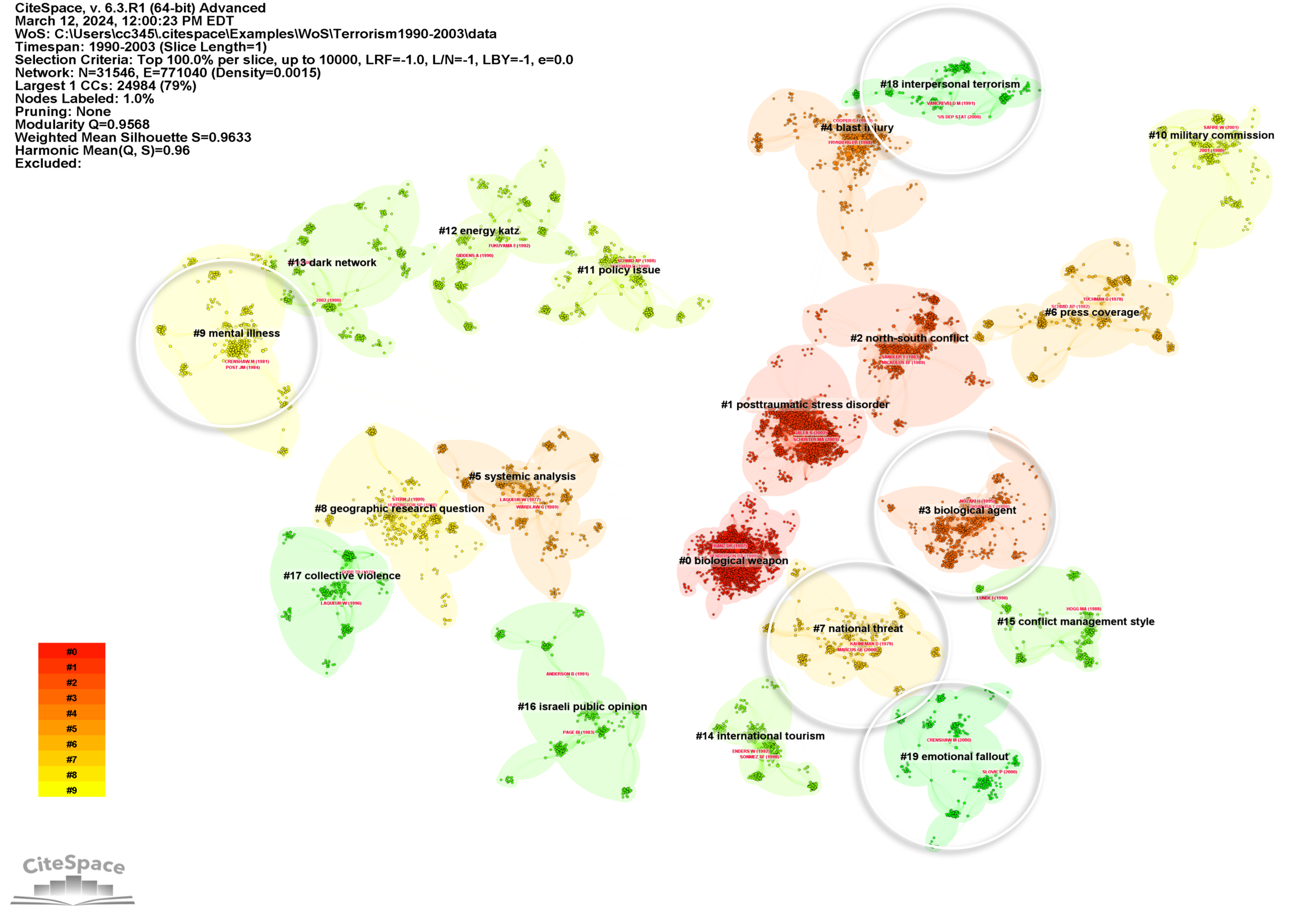
Time slicing spreads out networks over time. As a result, topics may have a better chance to form their own clusters. Thus, it is suitable to apply to the study of a field with a fast-moving pace. In contrast, a non-time slicing configuration may be suitable to identify topics that may take a long period of time to accumulate and form distinct clusters.