8/24/2024
If you are new to CiteSpace, watch this 13-min demo first. 初学者请参考这个入门视频。
This video demonstrates how to search and download data from the Web of Science on inflation and economy, how to preprocess the data, then create and configure a new project. The following steps are demonstrated:
All-in-One, optimize layout, cluster dependencies, label clusters with GPT models, summarize clusters in a summary report, link walkthrough, cluster explorer, and burst detection.
June 24, 2024
Here is the video of my presentation at the LLC Workshop "Philosophy of Science Meets Quantitative Studies of Science" (University of Turin, 27-29 May 2024).
8/23/2024
8/29/2024
How can we visually explore how review papers differ from original research papers in terms of what they cite and what they don't cite? How can we find research areas that may be heavily funded by a particular funding source but not by others? What is the coverage of the literature landscape by a particular collection of scholarly publications? Using a network overlay in CiteSpace may set these questions in a broader context.
8/23/2024
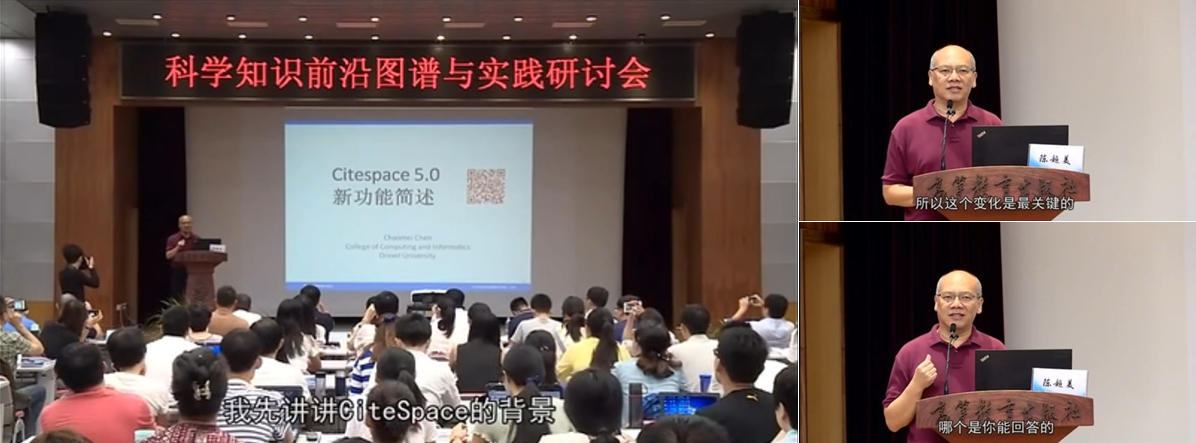
黑龙江大学讲座 2025年1月18日
https://doi.org/10.5281/zenodo.14690461
The following AI-generated highlights of the presentation are about 97% accurate. 下面由AI生成的要点大约具有97%的准确率。
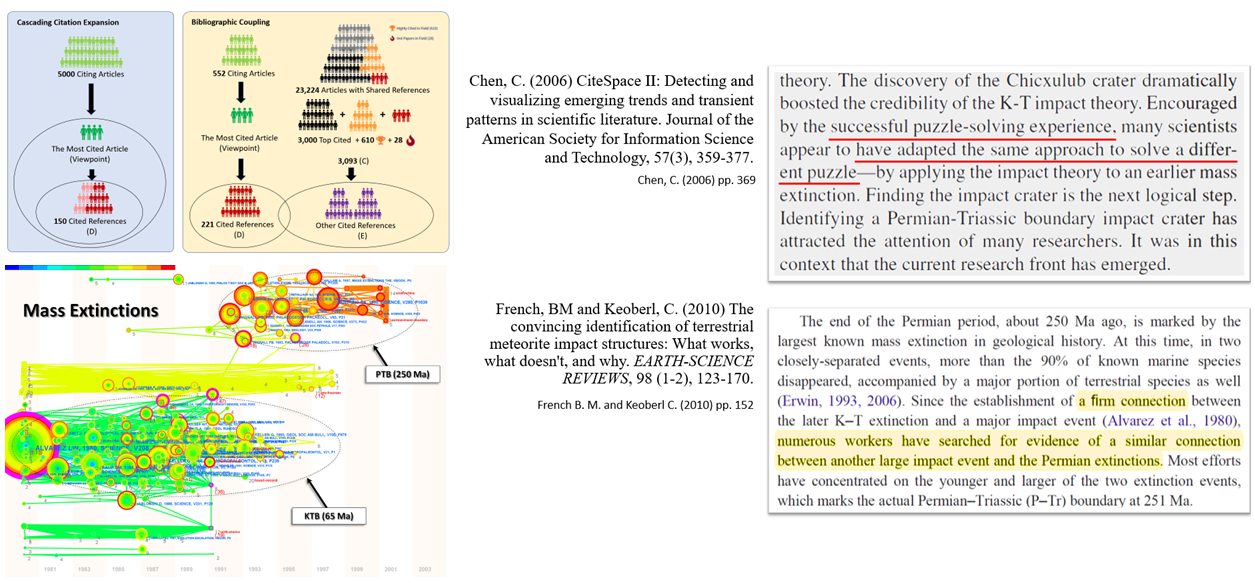
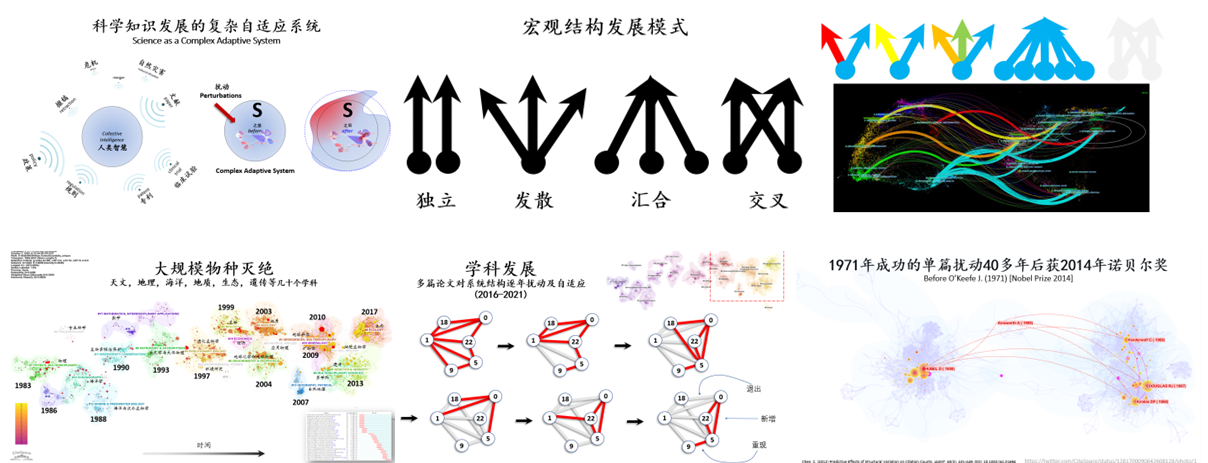
The presentation examines the evolution of scientific frontiers by conceptualizing scientific knowledge as a complex adaptive system. It emphasizes the crucial role of meta-knowledge, visual analytics, and citation network analysis in identifying emerging trends, paradigm shifts, and the broader dynamics within research fields.
One of the most compelling ideas presented is that the most valuable information is that which has the potential to drive structural changes at the system level. This suggests that breakthrough research is not only characterized by novelty but also by its ability to create perturbations that reshape knowledge networks. This perspective is particularly thought-provoking as it shifts the focus from incremental knowledge accumulation to recognizing transformative insights.
The concept of multi-level recombination in scientific evolution is another key highlight of the presentation. It illustrates how knowledge domains evolve through processes such as fragmentation, integration, and cross-disciplinary convergence. This framework provides a structured explanation for how novel ideas emerge and how scientific revolutions unfold.
However, the idea that citation bursts can reliably predict scientific impact carries a degree of uncertainty. While citation networks can reveal historical patterns, the assumption that early citation surges directly translate into long-term influence lacks robustness. Scientific recognition is often influenced by a complex interplay of social, political, and technological factors that extend beyond citation metrics.
The presentation also posits that meta-knowledge alone—leveraging citation network analysis—can effectively map scientific breakthroughs. However, this perspective underestimates the significance of non-bibliometric factors such as tacit knowledge, informal scientific communication, and serendipity, which recent literature has identified as critical drivers of knowledge diffusion.
The most valuable takeaway is that meta-knowledge allows researchers to transcend the boundaries of their immediate fields, enabling them to identify transformative patterns in scientific evolution. By integrating visual analytics, information science, and artificial intelligence, researchers can refine their strategies for knowledge discovery and foster innovation more effectively.
本次演讲探讨了科学前沿的演化过程,并将科学知识体系视为一个复杂适应系统。演讲强调了元知识(meta-knowledge)、可视化分析(visual analytics)和引文网络分析(citation network analysis)在揭示新兴趋势、范式转变及研究领域动态变化中的核心作用。
演讲中最具启发性的观点之一是:最有价值的信息是能够在系统层面引发结构性变革的信息。这意味着,突破性的研究不仅需要具备新颖性,还必须能够在知识网络中引发扰动(perturbations),从而重塑学术格局。这一观点极具深远意义,因为它将关注点从渐进式的知识积累转向对变革性发现的识别。
演讲还提出了科学前沿的多层次交叉重组(multi-level recombination)概念,并展示了知识领域如何通过分裂(fragmentation)、整合(integration)和跨学科融合(cross-disciplinary convergence)等机制不断演化。这一观点提供了一种结构化的解释,揭示了新思想如何孕育,以及科学革命如何展开。
然而,引文突增(citation bursts)能够可靠预测科学影响力这一观点仍存在较大的不确定性。尽管引文网络能够揭示历史趋势,但早期突增是否必然与长期影响力相关,尚缺乏足够的实证支持。科学认可的形成往往受社会、政治和技术等多重因素影响,而不仅仅由引文动态所决定。
此外,演讲提出,仅依靠元知识(meta-knowledge)及引文网络分析就能够有效追踪科学突破。然而,这种观点可能低估了非文献计量因素(non-bibliometric factors)的重要性,如隐性知识(tacit knowledge)、非正式学术交流(informal scientific communication)以及偶然性发现(serendipity)。近年来的研究表明,这些因素在知识扩散过程中起到了至关重要的作用。
本次演讲最重要的启示在于,元知识使研究人员能够突破自身学科的限制,识别科学演化中的变革性模式。通过整合可视化分析、信息科学和人工智能,研究人员可以更有效地优化其知识发现策略,推动创新发展。
October 17, 2023
Alternating Cluster Labels
“学科交叉与交叉学科发展与评价”论坛
October 10, 2022
International Conference on ICT enhanced Social Sciences and Humanities
Keynote, June 28, 2021
2016