- Dec 27, 2024
Structural Variation Analysis (SVA)
- Chaomei Chen
- 0 comments
Researchers pursue new ideas quite often if they don't do that all the time. A commonly known approach to be creative is to connect previously disparate concepts, topics, opinions, and the like. Sometimes more and more people are convinced and they start to follow, expand, or extend the newly conceived connection. Other times, reactions may be limited. In a 2012 JASIST paper (Chen 2012), I initially proposed the Structural Variation Theory to guide the search for new publications with a great potential to change the landscape of a field of research.
Basic Idea
The basic idea is simple. If the state of the art of a field of research can be seen as a network of a few building blocks of highly concentrated and coherent topics, then the most valuable insights would tell us how the network structure at the block level might change in the future. We can envisage a scenario of an abstract version of continental shift, where a continent is a tightly coupled collection of entities as a finer level of granularity and these entities have a lot in common within their own continent. In a macroscopic view, the entire system would remain in a business as usual state unless some continents change, for example, they merge with other continents or they are divided into smaller continents. Whatever information that leads to such changes is considered critical and crucial.
Another important observation is that two continents may not necessarily end up together despite someone starts to pull them closer. This is the meaning of the word potential in this context. It is, nevertheless, insightful enough to draw our attention to such potential.
Measurements
In CiteSpace, if an author cited publications from different continents, the author is in effect establishing a new connection if no one else has done that so far or the author is strengthening an existing one. If this particular connection gets stronger and stronger, one day it could become strong enough to alter the structure of the system.
Two kinds of papers are most likely to demonstrate this type of long-range cross-continent linkage: review papers and creative papers of original research. With the category of review papers, not all review papers are equal; some review papers make contributions that indeed forge a new path forward.
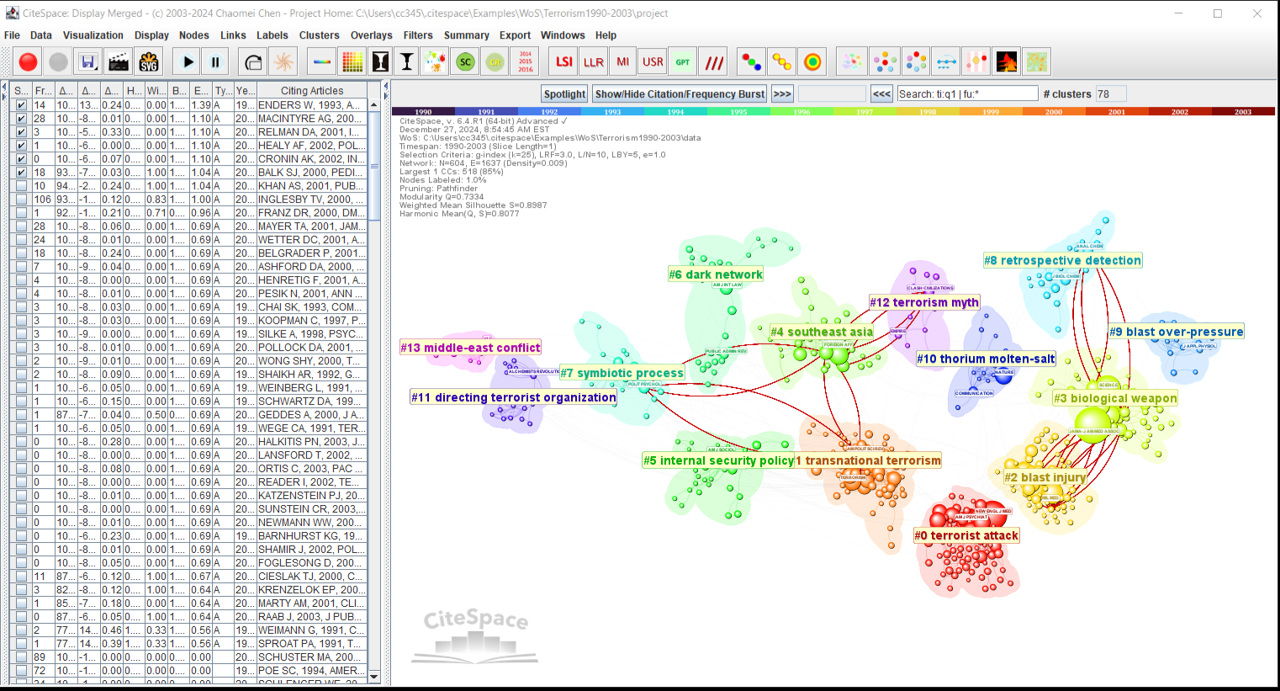
As you can see the links in red in the image below connect different continents. According to the Structural Variation Theory, we ought to watch this type of papers closely. Since the measurement is purely based on intrinsic information at the time of publication, we don't need to wait till it has gathered enough citations to determine whether they are potentially attention worthy. In our 2021 study, Sebastian and I demonstrated the boundary-spanning mechanisms in Nobel Prize winning papers. In one of the Nobel Prize case, the time span from the first sign of such potential (retrospectively looking of course as we rewind the clock) to it settled with a Nobel Prize was 40 years!
Video
For a broader context, see my talk on May 27, 2024 at the Int'l Workshop on Philosophy of Science Meets Quantitative Studies of Science, Turin, May 27-29, 2024.
Slides: Visual Analytic Studies of Science: Changing What You See and How You See Science. https://doi.org/10.13140/RG.2.2.33206.51529
Video: https://youtu.be/t-BbGhxLkH4?si=bs9WyMcvxCAFtigw
References
Chen, C. (2012) Predictive effects of structural variation on citation counts. Journal of the American Society for Information Science and Technology, 63(3), 431-449. https://doi.org/10.1002/asi.21694
Sebastian, Y. and Chen, C. (2021) The Boundary-Spanning Mechanisms of Nobel Prize Winning Papers. PLoS ONE 16 (8), e0254744 doi: 10.1371/journal.pone.02547